

Essential Commercial Property Maintenance Services for Busy Tenants
Nobody enjoys dealing with a leak under their kitchen sink, and few would be thrilled if their HVAC failed mid-shift, forcing them to arrange a qualified repair instead of serving customers or preparing orders.
There are plenty of reasons why commercial tenants benefit from property maintenance services, so consider some of the main ones to keep in mind when managing your space.
Key actions are worth putting in place.
What You’ll Learn
- First, Know Who Handles What
- Cleaning, Waste and Shared Areas
- Keep HVAC, Plumbing and Power on a Schedule
- Make Outside Areas Safe and Usable
- Make Service Requests Easy to Follow
- Wrapping It Up
First, Know Who Handles What
The first step is to familiarise yourself with the terms in your lease agreement, to know what you’re responsible for and what you can delegate to the landlord or property manager.
The lease may assign upkeep inside the rented unit to the tenant, shared-area or major-system work to the landlord, and a share of common-area costs to the tenant.
As such, it’s wise to understand the extent of your responsibility, the landlord’s, and any financial contribution that may be required from you. Always ensure you know who to liaise with regarding repairs, and keep your team informed of who to contact and what steps to take in case of hazards, and how to ensure customer & member safety.
As a good practice, always have a picture of the faulty item taken and stored, ready for when the repairer comes to remedy the situation, or can be referenced at a later date.
Cleaning, Waste and Shared Areas
Ensuring the commercial property is clean, presentable, and well-managed is imperative, both to attract footfall but also to allow customers, members, and staff to feel comfortable in the space, and conduct business efficiently.
When looking to procure commercial property maintenance in Memphis, there are various components to consider, including exterior maintenance, general cleaning, and ad-hoc repair, that your property manager may be able to facilitate or authorise, depending on the location and your lease.
You should aim to identify high-touch points, such as your reception, toilets, kitchen, handrails, and paths, and devise a suitable schedule for cleaning and replenishing stock, based on expected numbers passing through.
Ensure that waste is collected, cleared, and removed from your site as frequently as required, and agree with your contractor on where skips, wheelie bins, etc., will be located, and how to manage additional waste (e.g. cartons, packaging) received on-site as a result of stock deliveries.
Likewise, agree with your landlord and/or cleaner on how, and how frequently, communal areas, e.g. external areas, corridors, frontage, and any communal waste, will be cleaned, cleared, and maintained.
Ensure that cleaning tasks which could cause disturbance, noise, and congestion, are performed at a time of day to avoid interfering with your opening hours, customer, member, and staff movement.
Keep HVAC, Plumbing and Power on a Schedule
Faults and disruptions to these essential services can adversely impact the ability of your customers, members, and staff to access, use, and occupy your commercial space, so it is important to be proactive in ensuring these operate correctly and efficiently, and to address any faults promptly, as soon as they arise.
You can enquire with your contractor about the frequency, and last date, that certain components of your HVAC, such as filters, drain pans, and ventilation components, were tested, cleaned, and cleared, and maintained to promote good air quality, as outlined by the EPA, here.
You can also monitor and log instances of inconsistent temperatures, air flow, blocked fans, etc., to inform future remedial work, as necessary, across the premises.
Similarly, it is prudent to stay vigilant of, and communicate, any leaks, blockages, damp, and other irregularities with your plumbing, and note any electrical failures, faults, or anomalies, to be assessed, tested, and rectified by the appropriate party, in line with your lease terms, as follows:
- Plumbing
- Electrical
- HVAC
The DOE recommends adhering to a planned preventative maintenance programme for HVAC, in order to enhance its efficiency, and mitigate against breakdowns, as noted here, although the frequency of servicing may vary by property and system installed.
You can ask your contractor to provide details of what has been carried out, what, if anything, requires further attention, and who is responsible, to inform your next course of action.
Make Outside Areas Safe and Usable
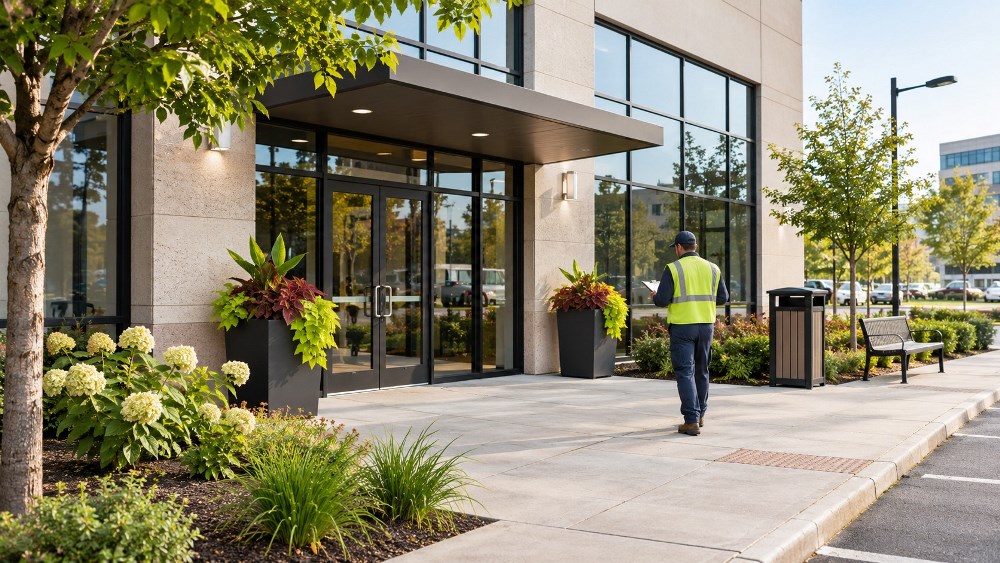
From the moment your staff, customers, and members arrive at your property, it is important that the external areas, including car parking, paths, and entrances, are in good order, with no obvious trip hazards, disrepair, obstruction, poor lighting, overgrowth, etc., to prevent injuries, and facilitate safe, easy access to the site, and onward movement of people, vehicles, and stock.
Additional inspections may need to be arranged after adverse weather, such as excessive rain, to check for pooling, drainage, etc. and/or wind, to check for foliage, rubbish, etc. that may have obstructed access, entrances, exits, or drains, etc. as a precaution and to remediate any damage, if found.
Report urgent safety hazards immediately to the designated property contact, and, as discussed, ensure the relevant parties are aware and any access restrictions are put in place, to maintain safety, until the area is restored and returned to normal operation, per the procedure agreed with your landlord.
Make Service Requests Easy to Follow
Ensure that, when requesting repairs, sufficient information is provided to the repairer, so they are able to effectively locate, assess, and address the fault, and resolve it, if possible, as quickly as possible, to minimise disruption.
Establish an appropriate, centralised method, e.g. email, portal, etc. by which your employees can raise and log repair requests, and include as many pertinent details, ideally with a photograph, as to:
- the nature of the issue;
- the location, and, if applicable, any directions, codes, etc. required to access it; and
- the level of urgency, and whether it poses an immediate threat to health, safety, or business operations, to aid prioritisation, and scheduling, of repair.
Avoid raising minor, low-risk, cosmetic faults, such as paint, plaster, floor, and other surface damage, as an urgent, unless they pose a significant risk, to differentiate from more serious, pressing, hazards, and allow your landlord to plan maintenance works, in line with your requirements, and priorities.
Always log, and, where possible, obtain written confirmation, of completed repair works, to retain for future reference, particularly for recurrent faults, to allow your contractor to trace, diagnose, and, if possible, correct, the root cause, rather than merely remediate the symptom, each time.
In practice, however, the easier, quicker, and more streamlined, you can make the process, the more likely your staff will follow it, especially during busy periods and ultimately, help staff report repair needs consistently.
Wrapping It Up
By checking your lease, scheduling upkeep, and reporting hazards promptly, you can reduce maintenance delays and disruption to daily business.


